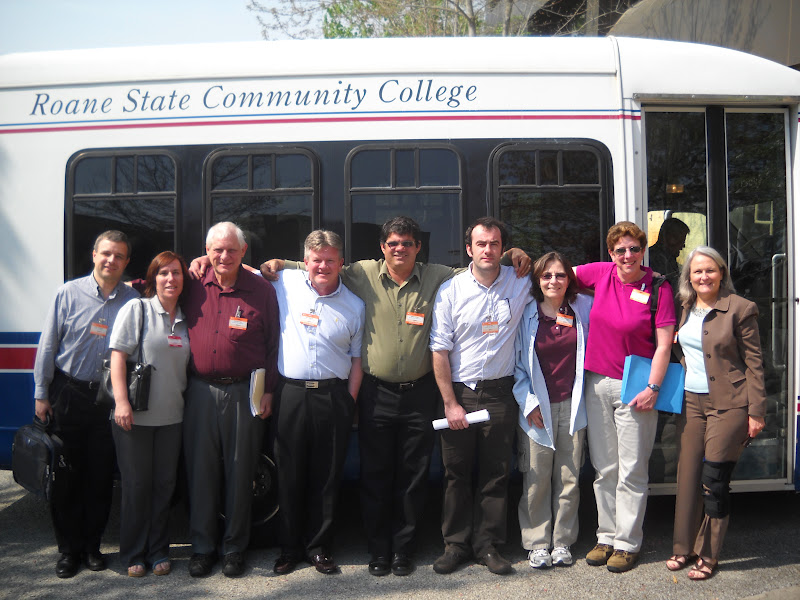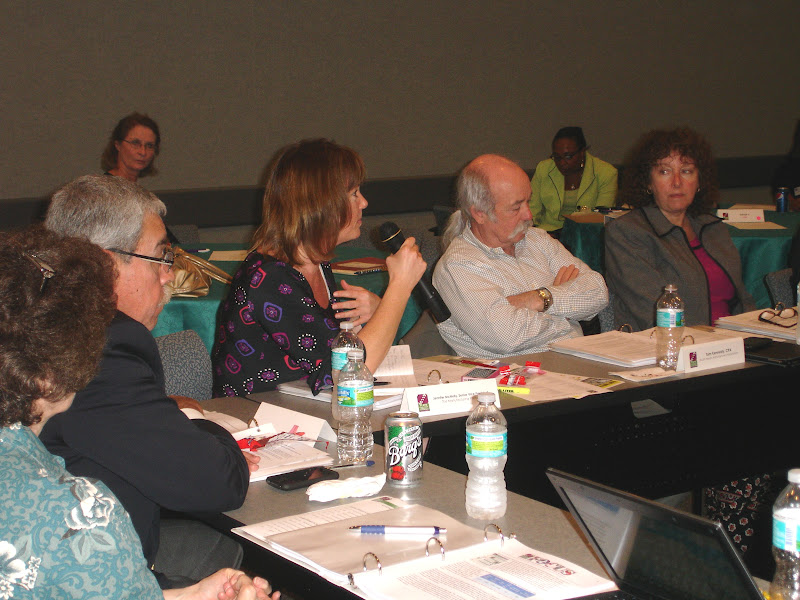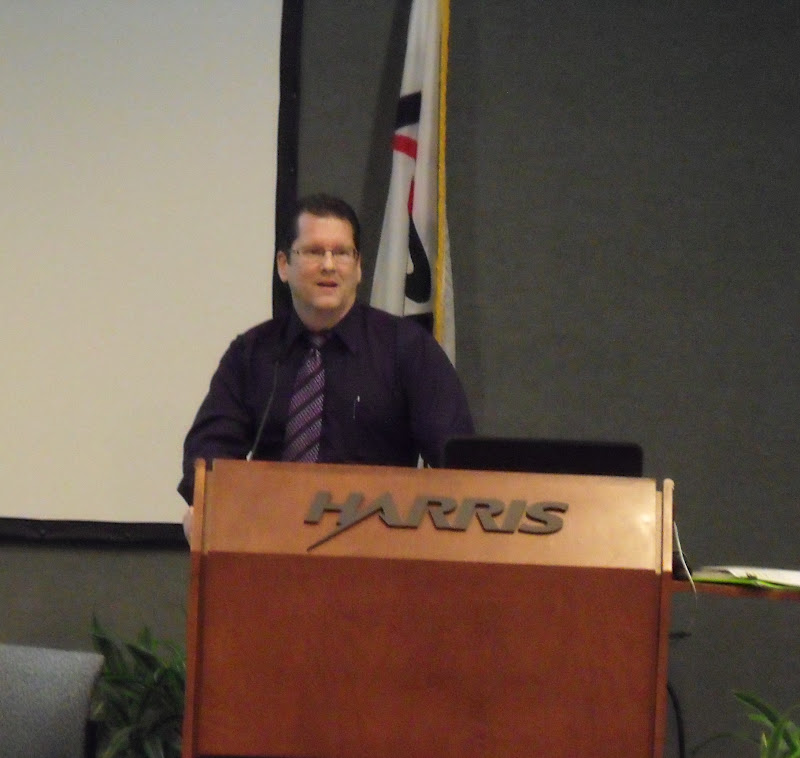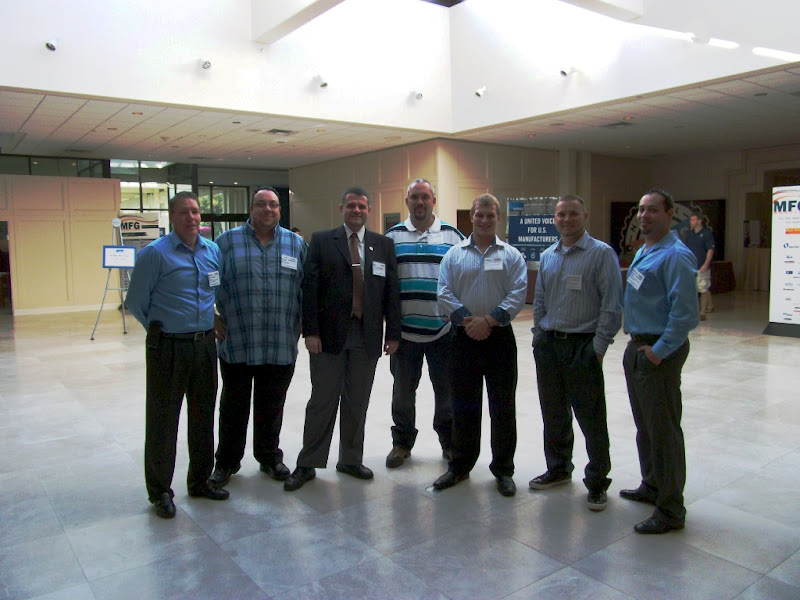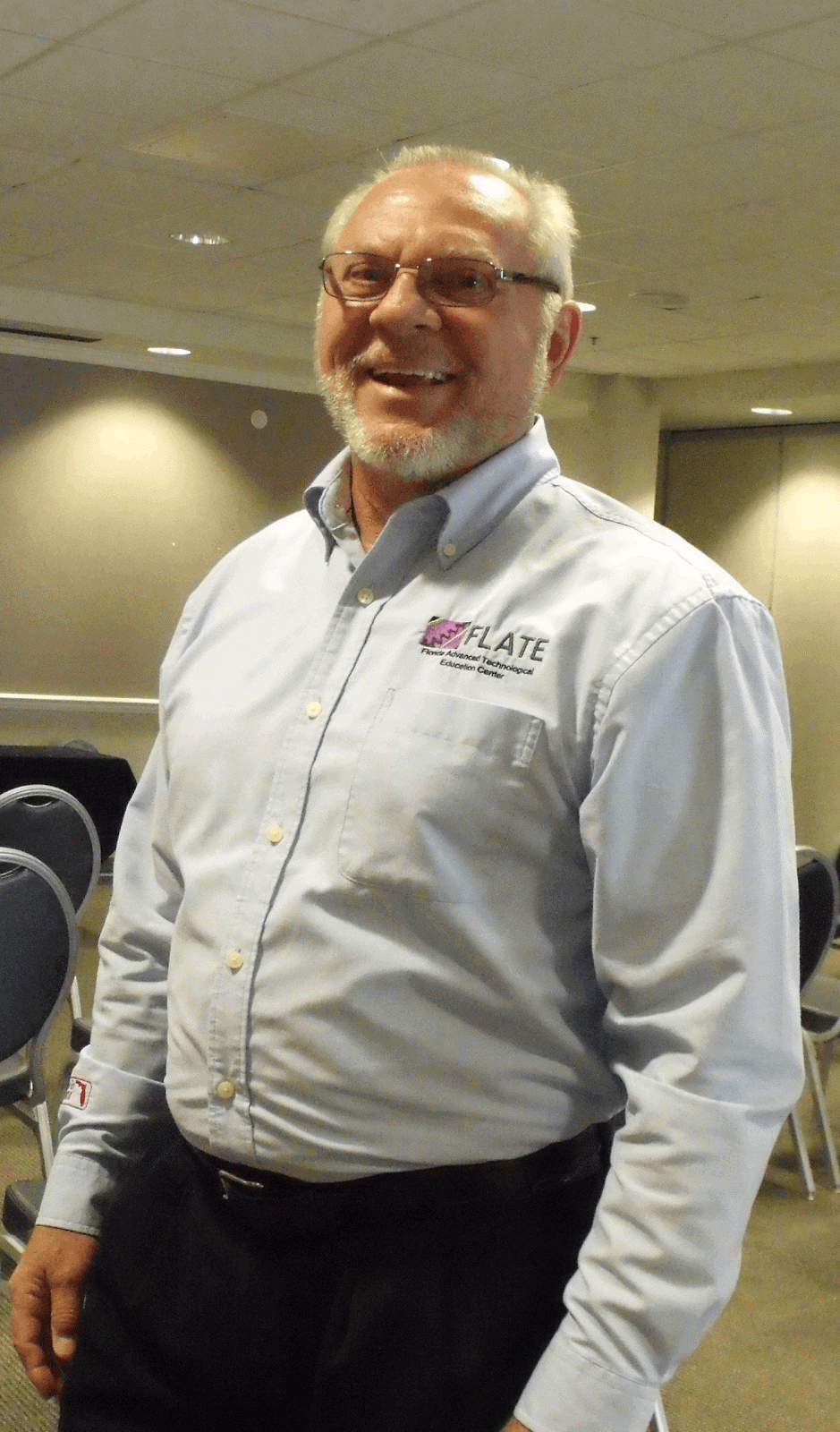
As a direct response to FLATE’s 2011 Stakeholder Survey, and inspired by Gov. Rick Scott’s comments and presentation at the 8th Annual Manufacturing Summit & Marketplace in 2011, FLATE initiated its “Manufacturing Year of Awareness” campaign. FLATE “kicked off” this effort in January 2012 during its 8th annual NSF National Visiting Committee meeting hosted this year by Harris Corporation in Melbourne, Florida. Through it all Dr. Marilyn Barger, PI & Executive Director of FLATE says “we hope these efforts continue to strengthen Florida’s leadership in the manufacturing renaissance.”
The workshop started with presentations by Art Hoelke, vice president and general manager at Knight’s Armament in Titusville, and Terry Iverson, president & CEO of Iverson & Company in Des Plaines, IL, who shared their outreach activity experiences. During the meeting attendees were asked to participate in an outreach activity focusing on manufacturing. Several common themes emerged, providing guidance for improving and designing future outreach efforts to increase the pipeline of students entering manufacturing-related careers.
Community Involvement and Support
Overwhelmingly attendees stressed the importance of having all stakeholders engaged and involved in outreach activities. The stakeholder list includes (but, is not limited to) manufacturers, students, teachers, education administrators, workforce and economic development boards, parents.
Industry Image
Unfortunately, the image/perception associated with the manufacturing industry is still not a positive one. Attendees agreed that educating and informing students (and parents) about the world of modern manufacturing and the opportunities available in the field is essential.
Manufacturing Support (especially local support) is of paramount importance, and partnerships should be fostered between all stakeholders (community, schools, manufacturers).
High School Focus
High school students emerged as the group that should be targeted most aggressively, with hands-on learning focused on content and skills relevant to students, and was cited as an essential component of manufacturing programs.
Industry Tours were listed as one of the most effective ways to expose students to manufacturing and emphasize the importance of STEM and its connections to manufacturing.
Parental Buy-In
Participants strongly agreed that without parental support, efforts to guide students into manufacturing careers can be very difficult, if not impossible. Educating and informing parents (and school personnel) to raise awareness is of key importance.
Advertising, Marketing and Publicity
Attendees emphasized the vital role targeted publicity plays in getting the word out. High quality, extensive advertising and marketing are essential to raise awareness and highlight the many manufacturing job opportunities available.
Dr. Marilyn Barger, executive director of FLATE says the goal is straight forward. “Through this activity we hope to develop executable proactive action plans to strengthen the perception of manufacturing within Florida communities and school districts.” As a part of the outreach activity, attendees were asked to create an action plan/blueprint for planning a Manufacturing Expo. Attendees agreed that a regional manufacturing expo would require the support of all stakeholders for funding, participation, organization and publicity. The consensus was that the Expo should be tailored to educating and informing students, parents, teachers and the community as a whole and focused on improving the image of the manufacturing industry as a whole.
At stated by Hoelke “I believe the number one message is to be involved.” FLATE proposes to use output from the workshop to coordinate various awareness activities. These include but are not limited to facilitating plant tours for middle and high school students and educators, outreach “tool kits” for each of the Regional Manufacturers Associations (RMA), participation in regional events to help promote technical education career paths, conduct teacher professional development workshops on manufacturing and its support technologies, and support the participation of FLDOE representatives at major RMA sponsored manufacturing career awareness events.
For information on the outreach activity, and about FLATE’s NVC visit https://www.fl-ate.org/committees/NVC.html, or contact Dr. Marilyn Barger at barger@fl-ate.org.
Meet Molly Woods—a machinist at Vulcan Machine Inc., one of FLATE’s strategic industry partners located in Tampa that specializes in custom aerospace machining and commercial precision manufacturing. Working with machines is second nature to Woods who has been working for Vulcan—her family owned business—since 2007. “From start to finish I like running the machines, cleaning the parts, and love the ‘hey I made that’ feeling.” Woods loves new challenges. Initially, she started doing basic work on the machines then moved to doing more complex tasks. On any given day, her work runs the gamut of working with six to seven different machines and ensuring they run smoothly. She works on CNC machines that manufacture parts for Vulcan’s aerospace customers. She is also responsible for operating the mills and lathes, uses different methods like fast bright to take the burr off the parts, and boxes the final product readying them for final shipment. “My job is highly productive and interesting” says Woods. “I love making parts and seeing the products that I manufacture can be used by another company.”
Indeed, a machinist’s job is not all work and no pay. Nationally, machinists can earn up to $18 dollars an hour, with average annual income of nearly 50K (Source: https://machinistsalary.org). In Florida, machinists can earn up to $23 an hour with a starting annual salary close to 30K. Not only is money a motivating factor, but working as a machinist offers tremendous opportunities, especially for women. According to the Department of Labor only 3.9% of the total machinist workforce is comprised of women (Source: Department of Labor). Woods agrees machining may not be a traditional pathway for women, but encourages women and girls of all ages to look into it as a viable educational and professional pathway that offers a rewarding career. The NIMS (National Institute of Metal Working skills) Certification for example (discussed in last month’s FLATE Focus) is a great way to get started and gain a nationally recognized industry certification. For Florida residents, the machining program at Pinellas Technical Center is another great way to add to one’s educational skill set. “You can do anything if you put your mind to it” says Woods. Besides, she adds, “it is fun to run the machines and be the only woman on the shop floor.”
For more information about the machining program at pTEC and the NIMS (National Institute of Metal Working Skills) Certification visit www.myptec.org. For information on FLATE’s industry aligned programs visit www.madeinflorida.org, and www.fl-ate.org, or contact Dr. Marilyn Barger at barger@fl-ate.org.
Innovation in manufacturing was definitely the common theme. Theoretical topics included the tricky fluid dynamics of spray cooling to lower the temperature of the power hungry, heat generating electronics that we all love. There were also talks on innovative uses of additive manufacturing for production, sustainable manufacturing, holograms measurement tools, and the open source MT Connect standard. The two day Forum was a game changer. Students got a first-hand overview of sustainable manufacturing practices, high speed milling, stabililty control, and innovations in defense manufacturing. They also got an up-close look at how the Joint Strike Fighter is manufactured, and were updated on MTConnect standards. It was an awesome day” said Barger. Students as well as educators were “energized by the presentations and the manufacturing professionals they met.” Byron Taylor, a current ET degree student at HCC-Brandon agrees with Barger. The Forum according to Taylor reinforced his interest in the field, and served as a pathway for him to “see the future of technology.”
In addition to the presentations, students attended two panel sessions that provided in-depth information on new and upcoming innovative technologies. During the tech briefs session, experts provided insight on electronics cooling, innovation within defense manufacturing, and the future of additive materials manufacturing. The panel discussion also shed light on precision engineering and various aspects of innovative machining technology, tooling and maintenance. “It is a very active time in manufacturing” said Nicholas Fields, a freshman at HCC enrolled in the ET degree. Fields was glad he had the opportunity to attend the Forum as it gave him the “tools to pursue a Bachelor of Science degree in engineering technology, or possibly in a biomedical field.”
For more information about the Forum visit https://www.amtonline.org. For information on FLATE and its award winning two year A.S. degree in Engineering Technology, currently offered in 11 community and state colleges in Florida, visit www.madeinflorida.org/engineering-technology-degree, or contact Dr. Marilyn Barger at barger@fl-ate.org.
FLATE News for March 2012 is that David Gula, FLATE Outreach Manager, is retiring this month. Dave tells us it’s his 5th, or so retirement. I haven’t probed back to the first one, but maybe this will be his last. Dave came to FLATE at our very beginnings, channeled to us from the Florida High Tech Corridor’s Tech Path’s efforts. In 2002, FLATE was still an idea with promise. The promise inspired the National Science Foundation’s Advanced Technological Education program to invest $70,000 in a “Planning Grant for one year for the FLATE leadership team to develop its “plan,” and define the regional and statewide need.” Looking for something to do and someplace to volunteer to help grow the pipeline of students interested in STEM career pathways, Dave started attending our NSF ATE Regional Center Planning Grant meetings. His contributions to our “volunteer” planning team’s activities and to our mission became so valuable that we convinced him to accept a contract to help us with our industry surveying during that period. This activity defined the need for educational reform for manufacturing education throughout the state.
Peter Buczynsky, owner of PharmaWorks, manufacturing company in Odessa FL wants to expand his business and move into a bigger facility. He can’t. New England Machinery, another manufacturer located in Manatee County, FL is looking to expand its payroll. So far it hasn’t. These companies are not holding back due to a hiring freeze. According to recent reports published in the Tampa Tribune and in the Sarasota Herald Tribune, they are being held back due to an acute shortage of skilled workers. As schools slash funding for technical programs, manufacturers across the board are increasingly finding it difficult to find skilled machinists, engineers and technicians.
assistant director at the Campus is a machinist supporter extraordinaire who says “every consumer and industrial product exists because of machining…our modern life completely depends on the hard work and ingenuity of machinists.” The mission of the program, he says, is to prepare students for employment as entry level machinists, tool makers, lathe operators, mill operator, grinding operators, electrical discharge machine (EDM) operators and computer numerical control (CNC) machine operator/basic programmers. “We offer a problem solving atmosphere, and we share with them our experiences, which allows them to learn and be excited with this program.”
System affords maximum flexibility for trainees and employers alike. In that, the system “rewards trainees enabling them to advance at their own pace in defined career ladders throughout the metalworking industry.” Using attained competencies in lieu of a rigid set of hours, employers are able to effectively monitor and measure progress and reward individual initiative. Roy Sweatman, owner and president of Southern Manufacturing Technologies, a precision custom high-tech manufacturer in Tampa, agrees the competency based learning offered by the pTEC Machining program helps students learn things at their own pace based on their competencies. “A lot of manufacturing has moved offshore, and a few of us are working on getting manufacturing back onshore, and the NIMS program is a step towards that direction.” Sweatman said.
Industry certification is undoubtedly the cornerstone of the program. In addition to the NIMS certification, the machining program offers four, 30 hour courses in Safety, Manufacturing Processes & Production, Quality Practices & Measurement, and Maintenance Awareness which is part of the national Manufacturing Skill Standards Council certification (MSSC). Upon graduation, students not only earn a certificate of completion from pTEC, but a certificate from the Department of Education, Apprenticeship Division as well as a NIMS and MSSC certifications. Students completing the program can also receive college credits that can be transferred to a four year engineering program in Florida. “Industry recognizes and values certifications which in turn increases compensation and employability opportunities” McClendon said.
Indeed, the machining program together with the NIMS and MSSC certification is a powerhouse for graduating students. Given the high demand for machinists across the nation, graduates are assured of several lucrative opportunities serving as machine operators, machinists, tool & dye makers, designers, engineers or even entrepreneurs and business owners. A great advantage to students is that they are highly marketable and can get a job anywhere in the country. A claim confirmed by Sweatman who says “if someone walks into my office with a NIMS credential I will hire them immediately.”
For more information on the NIMS certification and the machining program at pTEC contact Eric McClendon at MCCLENDONE@pcsb.org, or visit www.myptec.org. For information on FLATE and its industry centered curriculum and outreach initiatives contact Dr. Marilyn Barger at barger@fl-ate.org, or visit www.fl-ate.org and www.madeinflorida.org.
Say you are a bicyclist who needs a console to mount a GPS to your bike’s handlebars, but don’t have the money, or equipment to produce a prototype of your invention. If you are innovative by nature, want to experiment transforming your ideas into making a product, a Fab Lab may be your Mecca. A Fab Lab or Fabrication Laboratory is a place where ideas come to life.
“gateway for lifelong adventures in science,” and was founded in 1990. The Fab Lab at the GWIZ museum came into being through the generous donations of Dr. Fritz Faulhaber who through the Faulhaber Family Foundation donated $400,000 to GWIZ to launch the project. It is a champion of science education not only in Sarasota County, but the entire state of Florida. What defines the fab lab is “personal manufacturing.” It is “custom creation” at its best. Its main purpose is to make one of a kind product rather than mass manufactured products. Although work in the fab lab entails using computers and computer-guided machinery, McGrath says the end result is a physical product, not merely a digital construction that ceases to exist when the lights are out. Given its mission to promote STEM (Science, Technology, Engineering and Mathematics) literacy through cross-disciplinary collaboration and innovation, the Faulhaber Fab Lab gives community members access to high-tech tools and materials as well as several high grade, industrial design and production equipment with simple design interface. The lab is equipped with CNC machines, manual metal cutting lathes, vinyl cutter, embroidery machines, CNC routers, soldering stations, and plasma cutters that enable users of all ages to make a number of products that range from plaques, puzzles, 3D portraits, gaskets, camera adaptors, or anything else they can think of.
helped, trained, mentored and supported students, teachers, as well as members from the community fine tune individual inventions using the latest cutting edge technology. McGrath describes the Fab Lab as “a space where people from all kinds of backgrounds can collaborate, create and brainstorm.” It is like a workshop, or a garage of the future that heavily promotes digital fabrication, and a place where “the practical applications of science, technology, engineering, mathematics and craftsmanship come into play.” Through it all, McGrath hopes to foster innovation, art, learning, craftsmanship, and the thrill of creating something from scratch, all the while promoting the understanding of STEM. For information on the Fab Lab at the Sarasota based GWIZ Science Museum contact Eric McGrath at ericm@gwiz.org, or visit www.gwiz.org. For information on FLATE’s STEM initiatives visit www.fl-ate.org and www.madeinflorida.org, or contact Dr. Marilyn Barger at barger@fl-ate.org.
Terms of Use | Privacy Statement