




At the FLATE–NAM (National Association of Manufacturers) Roundtable last week, Emily Stover DeRocco, president of the Manufacturing Institute engaged an audience of more than 30 Florida manufacturing stakeholders and FLATE’s National Visiting Committee. DeRocco encouraged the audience to endorse the NAM Skills Certification System of Stackable credentials.
The message was clear, now is the time to strengthen and grow manufacturing in the U.S. by strengthening and growing a 21st century manufacturing workforce. Incre asing the pipeline of young people coming through typical educational channels has proven difficult, and recent data reveals that although many people clearly place high economic value on the manufacturing sector, they do not support their children working in manufacturing. Beyond recruitment problems lies the workforce need for increasingly complex skills in new work environments. To that extent, DeRocco emphasized the importance of and need for a skilled and educated workforce, marrying the required high-tech skills which the modern manufacturing industry requires with an education that prepares workers to be operationally literate in mathematics, communication, and develop integrated thinking/problem solving skills.
The nationally vetted stackable credentialing system includes rigorous performance criteria and is the best we have to date. The system has the potential to evolve into a robust and responsive system, cl osely tying training for high-tech skills to the country’s education system, at the same time providing Florida’s manufacturers and high-technology industries with a needed pipeline of qualified workers. The Engineering Technology A.S. /A.A.S. degree career pathway together with its model statewide articulation for the MSSC certification provides a strong educational model which supports the foundational tiers of the NAM stackable credential system.
FLATE is proud to be at the forefront of this initiative, and will continue to work closely with Florida’s educational community, industries and NAM as the system evolves to increase the alignment of national credentials with the engineering technology degree and its deployment in Florida’s education system. Emily De Rocco’s presentation at Valpak can be accessed on the FLATE website, www.fl-ate.org/committees/NVC, and information about the Engineering Technology degree can be found at www.madeinflorida.org/ET_degree.
Enjoy the great stories in this February edition of the FLATE Focus where the spotlight is on Catrike—one of the 2009 MAF Manufacturers of the Year. Join FLATE as we visit the Lego™ League’s December competition hosted by FLATE and Hillsborough Community College in Brandon; learn about a new career academy created through a partnership between Northup-Grumman and Wekiva High School, and try your skills on puzzle #4 in our “sTEm at Work” puzzle series and submit your answer on our homepage.
 Dreams they say are built on passion and commitment. When Paulo Camasmie went after his long-time passion to “build” things, he did not know the answer lay in aluminum. The enlightenment came while riding through the hills in Sao Paulo, Brazil when he spotted a beauty—a retro diamond back bicycle that gleamed in style, ease and comfort. Thereon, he latched onto an idea that today has blossomed into an organization that is firmly rooted in “Quality—quality that comes before cost”.
Camasmie did not re-invent the wheel. He built the “third” wheel, literally. His company, Big Cat Human Powered Vehicles, is the manufacturer of lightweight recumbent tricycles “Catrikes”, located in Winter Garden, FL. From a small operation out of his garage, Camasmie’s dream has truly revolutionized the concept of riding. Catrike is a global giant in manufacturing recumbent trikes. It currently manufactures more than 100 trikes per month, and has stores located all over the world.
“Good is never good enough”. The design and engineering of its produc ts are rooted in the founder’s passion for mechanical engineering. Man, woman or child—there is a Catrike customized to suit everyone’s personal and budgetary preferences. Starting with the Catrike C2000, the company has expanded its production line to include some hallmark designs like the Aluminum Catrike Road, Catrike Speed, Catrike Road, Tadpole trikes, Catrike Pocket etc. These design feats are a testament of the company’s use of alternative materials, fabrication and manufacturing techniques to remain competitive in a global market.
In many ways the company is its biggest competitor. Reflecting the belief of its founder—“Comparing ourselves to ourselves”—Catrike is constantly evolving and refining its extensive product line. Over the years, the company has heavily invested in new equipment to create ‘manufacturing cells’ which will enhance the quality of its products, allow Catrike to triple its output, cut the cycle time in half and maximize accuracy. It utilizes SolidWorks in the design department, and has a new inventory and scheduling system for proper supply chain management locked in gear.
Indeed, Catrike is an award winning manufacturer. In 2009, it was named small manufacturer of the year by the Manufacturers Association of Florida. Catrike is also working with FLATE to design a virtual tour, and a new “Made in Florida” Challenge that gives a real-world view of modern manufacturing facilities in Florida.
For more information on Catrike and its products visit https://www.catrike.com/. In the words of Rick Steves—until next time, keep on traveling!
Catrike Promo Videos on YouTube
So you walk into a store, scan the barcode to check the price of an item, and us e a cell phone to inform a friend about the deal. Voila! You just took advantage of laser and photonics technology—the science capitalizing on the technology of light.
Photonics is the science of light that entails controlled flow of photons or light particles. It involves use of cutting-edge lasers, optics, fiber-optics, and electro-optical devices in numerous and diverse fields such as manufacturing, health care and aerospace technologies. Indeed, photonics is one of the fastest growing high-tech industries in the world, and the demand for qualified personnel is at an all-time high.
Given its potential and varied applications, Orange County Public Schools (OCPS) recently took a leading role in establishing a laser and photonics academy at Wekiva High School. The academy was established in December, 2009 and is a collaborative effort between Northrup Grumman, Valencia Community College and OCPS. As part of the partnership, Northrup Grumman invested $50,000 in equipment and funds, while VCC will be providing the curriculum, on-site electrical test equipment and staff needed to support the program.
The Wekiva High School Laser and Photonics Career Academy currently has 38 students enrolled in the program, and is the first of its kind in Florida. Courses include mathematics, science, communications, electronics, and optics. Students also gain laboratory experience by using state-of-the art equipment that prepares them to operate and maintain laser and photonics-based systems.
Nasser Hedayat, dean of architecture, engineering and technology at VCC says “The program is designed to train students for careers in manufacturing, or building circuit devices that use optical or laser technology”. To qualify students need to be in the 9th grade, have an overall 2.5 GPA, and fill out a dual enrollment form at VCC. Upon successful completion of the program students have the flexibility to enter the workforce and secure entry-level positions as an engineering, manufacturing, laser, photonics technician, or continue their formal education towards a degree at the college level.
Eight high schools currently participate in this dual enrollment program that allows students to earn 48 college credits towards an Associate of Science degree. Hedayat says the ultimate plan is for the high school students to complete the laser and photonics specialization of the electronics engineering technology degree at VCC. “Northrup and Lockeed Martin are two major companies in the area and they have a great need for technicians that are proficient in using laser photonics technology”.
For more information on the program call Professor Ali Notash at 407.582.1937, or visit https://www.wekivahigh.ocps.net/.
Your latest technician challenge deals with an assignment at a medical testing facility.
For whatever reason the two curves below were not labeled after the tests were completed. After checking the records you have learned the blood work was for B.J. Moose. The workup was to analyse his myoglobin and hemoglobin stress test result. You have decided that the curve (b) is the myoglobin results. Did the physician agree with you?

To submit your answers visit www.fl-ate.org. You click on the graph to enlarge the puzzle.
The 2010 Florida Lego League (FLL) season for Hillsborough County kicked into high-gear as 16 teams from across Tampa bay engaged in a series of challenges geared to sharpen the understanding of science, technology, engineering, and mathematics using a robotic platform. This one-day robotics tournament was held in December at Hillsborough Community College in Brandon, and was made possible through a partnership between FLATE, HCC-Brandon, TechPlayZone and various other community sponsors like Bright House Networks and Circa You.
Dr. Carlos Soto, president of HCC-Brandon said he was “pleased to host a competition that gives young people first-hand knowledge about robotics, and encourages them to e ngage in science, technology, and research”. Smart Moves—the theme for the 2009-2010 challenges –encouraged teams to explore existing problems regarding various modes of transportation in their communities. Each team was responsible for identifying a transportation problem and providing an innovative solution based on research conducted by the teams. Teams were also assigned to build a robot that could complete as many missions as possible in a head-to-head round, lasting 2.5 minutes.
The activities sharpened teamwork, prowess in technical design, presentation skills, encouraged STEM course enrollment through robotic activities , and served as an extension of the robotics camps hosted by FLATE every summer. It was also an effective mechanism in showcasing the “fun” side of science, mathematics and technology. Desh Bagley, founder and CEO TechPlayzone—a science and technology center located in Riverview, FL that offers workshops in robotics, video game creation and animation—said the competition served as a platform for teaching the applicability of robotics in everyday situations. “The best part of the competition was how the various entities of our community came together to make the event possible” Bagley said.
For more information about FIRST Lego League and the Suncoast FLL Tournament at HCC-Brandon, visit https://www.suncoastfl.org/. For information about TechPlayzone’s robotics program for young people call (813) 684-7329, or visit www.techplayzone.com/techplay. To learn more about FLATE at HCC, visit https://www.fl-ate.org/.
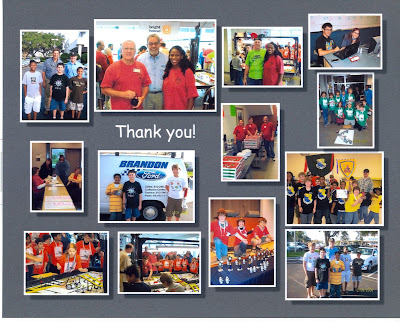
Snapshot of participants, winners and organizers at the FLL competition in HCC-Brandon
 Students throughout North America can win a trip to Washington D.C., win a $1,000 for their school, or other prizes by submitting their creative energy ideas to the ninth annual Igniting Creative Energy (ICE) Challenge.
The National Energy Foundation and Johnson Controls are currently inviting kindergarten through 12th grade students to submit innovative ideas on energy and the environment to the national competition. The ICE Challenge is a program developed to encourage students to share creative ideas that save energy and help conserve the environment. Since 2002, more than 13,000 students have participated for a chance to win national and state prizes, including a grand prize trip to Washington D.C., MP3 players, and $1,000 grants for their schools. This year, all qualifying submissions received before the *early bird* deadline of January 30, 2010 will be eligible to win one of several prizes that promote living in a more sustainable manner. Regular entry deadline is Friday, Feb. 19, 2010.
Bob Poulson, president of the National Energy Foundation says “The Igniting Creative Energy Challenge aligns with our mission to cultivate and promote future energy leaders. It provides participants an opportunity to make a positive impact in their communities through environmental and energy awareness.”
For details watch the video, or visit https://www.ignitingcreativeenergy.org/
Welcome to the first issue of the 2010 Newsletter. I hope everyone is getting off to a good start in the New Year. At FLATE we are busy preparing for the annual meeting of our National Visiting Committee (NVC). This committee is one of several assessment tools that the National Science Foundation (NSF) uses to gauge the progress and success of its larger projects and centers. On January 28-29 we will hold our 6th NVC meeting. Traditionally, the NVC provides an NSF center assessment and advice as a formal report to NSF. Members are also advocates for the center’s mission and vision. The NVC is also charged to participate in long term strategic planning for a center’s sustainability. FLATE’s NVC membership and past meeting information can be found on the NVC page on our website (www.fl-ate.org/committees/nvc.htm).
This year’s meeting, to be held at the ValPak Manufacturing Center in Pinellas County, kicks off our second round of funding from NSF. We are also very pleased to have Emily Stover DeRocco, president of the Manufacturing Institute of the National Association of Manufacturers (NAM) with us on Friday morning. She will share NAM’s recently endorsed Manufacturing Skills Certification System and lead a discussion about its deployment in the state.
FLATE has already developed a strong foundational piece of this system in its Engineering Technology Degree. The system endorses a “stack” of credentials at various skill and knowledge levels that can and should be aligned with local educational programs. The Manufacturing Skills Standards Council Certified Production Technician (MSSC CPT) credential is part of NAM’s system. It is also the core of the FLATE developed engineering technology degree that articulates 15 credit hours of the technical core to anyone holding a valid MSSC CPT credential.
Nine colleges in Florida are now offering the ET degree with one or more specialization tracks. Additionally, several high schools have adopted the FLATE-developed Automation and Production program, which is also aligned to the MSSC certification. Some questions we will discuss include: How the Florida Manufacturing community views the NAM-endorsed system; what components are most important here; how can we expand the existing foundational structure that FLATE has built and begun implementing; what support can FLATE provide?
Please take a moment to read the articles in our first 2010 edition of the FLATE Focus. I wish you a happy new year, and look forward to working with you.


Local festivities in Spain over the holidays.
 FLATE-led initiative to create a statewide Engineering Technology degree has established a unified curriculum to meet the demands of advanced technology industries in Florida. The State College of Florida (SCF) in Sarasota and Hillsborough Community College (HCC) in Brandon adopted the program in 2009, and enjoy robust participation from faculty and students alike.
HCC offers the Engineering Technology A.S and A.A.S degree with a specialization in advanced manuf acturing, along with four college credit certificates: Automation, Engineering Technology Support; Lean Manufacturing, and Pneumatics, Hydraulics, and Motors for Manufacturing. SCF currently offers the A.A.S degree with certificates in AutoCAD and Electronics, with plans to add a sequence of Solid Works, and expand the AutoCAD program to Digital Design and Modeling.
A common component of the program lies in developing critical thinking and tangible skills, and educators play a central role in igniting students’ interest. Dr. Adrienne Gould-Choquette, instructor and program director for engineering technology and construction management technology at SCF advises colleagues and fellow educators to “keep a watchful eye” to ensure the material that is being taught is not only relevant, but “instills honor and excitement in the profession”.
In terms of skills, Dr. Alessandro Anzalone, engineering technology instructor and program manager at HCC states students need to have transferable skills, have an open/inquisitive mind, enjoy engaging in hands-on activities, and be eager to learn new things. Thus, the type of learning offered in Engineering Technology degree programs provides students with critical thinking and transferable career skills. “This country was built on the innovation of minds trained as engineers…stretch your mind and your thinking, and the possibilities become infinite” Choquette said.
Looking to the future, Dr. Anzalone foresees a growth in the demand for trained/skilled people in the technology field. This spring he will serve as part of an advisory committee comprising of industry personnel, students and educators to review the current ET program, provide recommen dations to improve the program, and strategize ways to better align the program to match workforce needs. The ET curriculum at SCF is also set to grow and evolve with the needs of the community. Topping the list are green technologies, implementing eLearning courses and partnering with local manufacturers to ensure students are prepared to embark on exciting opportunities upon graduation. “During this time of economic struggle, students can look at this moment as an opportunity to hone their skills and be ready for the next exciting technology to emerge in this country, or better yet, be the one to invent it” Choquette said.
The ET degree consists of a common technical core with five specialization tracks in advanced manufacturing, quality, mechanical design & fabrication, electronics, and advanced technology. The common core of the degree aligns with the national Manufacturing Skill Standards Council’s (MSSC) Certified Production Technician (CPT) credential and four its assessment areas of safety, quality and measurements, manufacturing processes and production, and maintenance awareness. The statewide articulation agreement awards 15 credit hours of the A.S. /A.A.S. Engineering Technology degree core for the MSSC CPT certification, and creates a pathway for certification holders from high school career academies, CTE programs, technical schools and incumbent workers to gain college credit for their acknowledged competencies.
For more information on the ET program at HCC contact Dr. Alessandro Anzalone at 813.253.7852/ aanzalone2@hccfl.edu. For information on the SCF program contact Dr. Adrienne Gould-Choquette at 941-752-5515/ gouldca@scf.edu. To read the full interview with Dr. Anzalone and Choquette visit our Facebook page.
2010 ET Course Listing at HCC & SCF


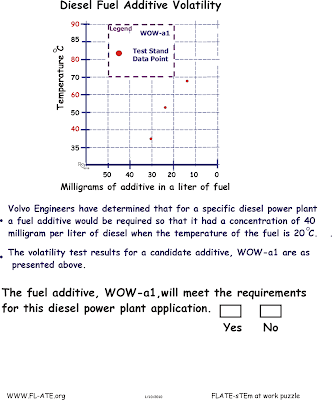
To bend that great line that Humphrey Bogart delivers toward the end of the movie “Treasure of the Sierra Nevada” –”Answers! Answers! We don’t need no stinking answers!!—We will continue with another puzzle and explore the answer later. Actually, at this point you may begin to see the theme behind this grouping of puzzles, but for now, here is the new situation. Someday there will be answers, promise!
This time your technical position is that of a fuel analysis specialist. The budget for this test series allows for three test stand data points to be obtained. That task done, your recommendation is also expected in the report.
(By the way, did the actor that delivered the real line “badges, badges, we don’t need no stinking badges!” become famous?)
Click on the graph to enlarge the puzzle and submit your answer!”